How to Reduce Power Consumption in Usha Air Coolers
A Usha air cooler can provide effective cooling without using as much electricity as many compressor-based air conditioners. To manage its electricity consumption, use the cooler only when needed, select a comfortable fan speed, maintain unobstructed airflow, and keep the appliance clean according to its model-specific instructions.
The most reliable way to understand your cooler’s electricity use is to check its rated wattage and calculate how many hours it operates. The right settings and maintenance routine can help you avoid unnecessary operation and maintain cooling performance, although actual savings depend on the model and how you use it.
1. Understand Your Usha Air Cooler’s Power Consumption
An air cooler’s power consumption depends on its electrical rating, operating mode and usage duration. Different Usha models have different specifications, so do not assume every model consumes the same amount of electricity.
For example, Usha lists the following power ratings for two Coolboy Breeze models:
Usha air cooler model | Published power rating |
Coolboy Breeze 35 L (35CBBP1) | 135 W |
Coolboy Breeze 40 L (40CBBP1) | 100 W |
These figures apply to the listed models, not the entire Usha range. Check your own model’s product specifications or rating label before estimating electricity use.
How to calculate electricity consumption
Electricity consumption is measured in kilowatt-hours (kWh), commonly called units on electricity bills.
Use this formula:
Electricity consumed (units) = Power in watts ÷ 1,000 × Operating hours
For example, if a cooler rated at 100 W operates for 8 hours:
100 ÷ 1,000 × 8 = 0.8 units
If the same rated-power calculation is applied over 30 days:
0.8 × 30 = 24 units
This is an illustrative estimate assuming the appliance draws 100 W throughout the operating period. Actual consumption may differ depending on the operating mode and the appliance’s real power draw.
To estimate the cost, multiply the units consumed by your applicable electricity tariff. Additional billing components may affect the final amount.
2. Choose an Appropriate Fan Speed
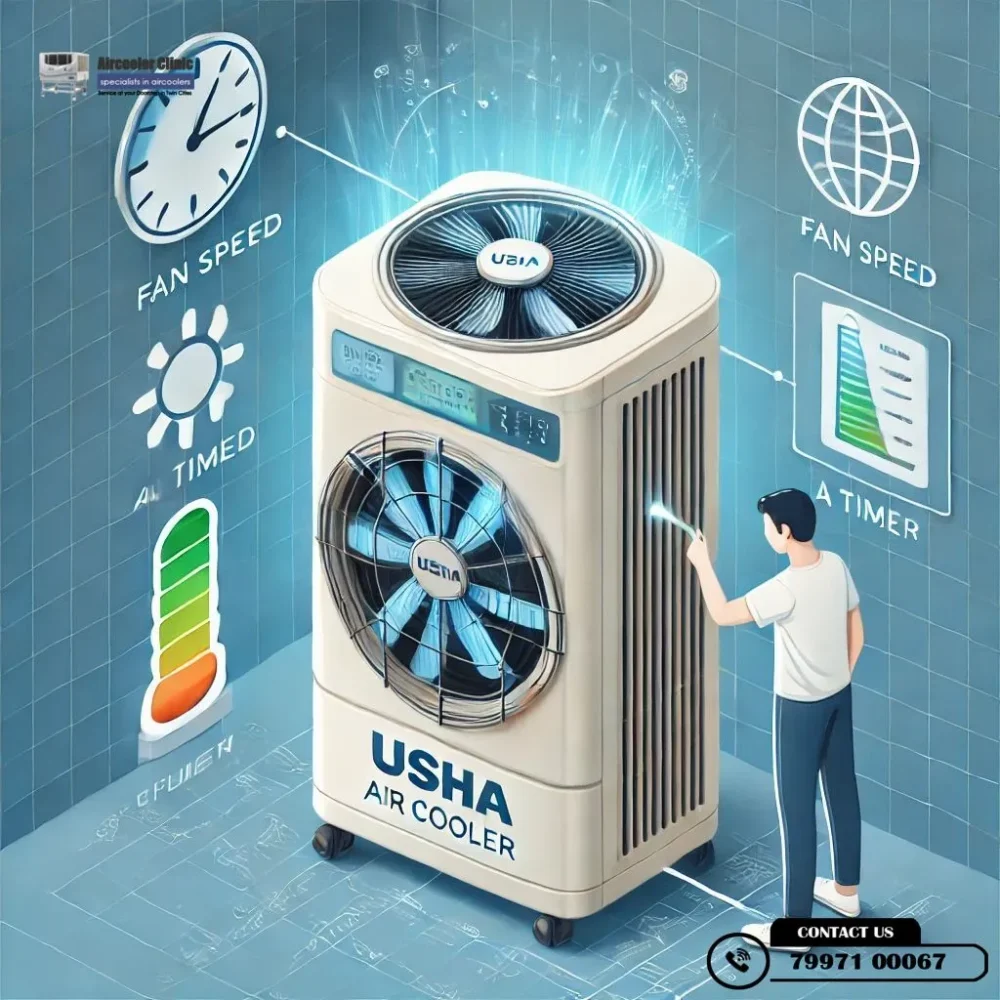
Usha air coolers may offer low, medium and high speed settings, depending on the model. Select the lowest speed that provides comfortable airflow for your room.
Practical suggestions:
- Start with a low or medium setting and increase it when you need more airflow.
- Use a higher setting when the additional airflow is necessary.
- Avoid running the cooler when nobody needs its cooling.
- If your model has a timer, use it to limit unnecessary operating hours.
Important: Do not assume that switching from high to medium speed will produce a particular percentage of electricity savings. The difference depends on the cooler’s design and actual power draw at each setting.
3. Turn Off the Cooler When It Is Not Needed
Reducing unnecessary operating time is a straightforward way to reduce electricity consumption.
For example, if you regularly leave the cooler running after leaving the room, switching it off when cooling is no longer needed can reduce total operating hours.
Consider these habits:
- Switch the cooler off when leaving the room for an extended period.
- Use a timer if your model supports one.
- Avoid leaving the appliance running overnight when it is not required.
- Check that the cooler is switched off before cleaning or relocating it.
The actual reduction in electricity use depends on how much operating time you eliminate.
4. Position the Cooler for Effective Airflow
Evaporative air coolers work best when they receive an adequate supply of fresh air and the room has suitable ventilation.
For practical placement:
- Position the cooler near an appropriate open window or doorway when possible.
- Keep the air inlet and outlet unobstructed.
- Avoid placing objects directly in front of the airflow.
- Maintain the clearances specified in your particular model’s manual.
- Provide an appropriate route for air to move through the room.
Usha’s Coolboy Breeze manual recommends operation near an open window and adequate cross-ventilation.
Better ventilation can improve cooling comfort. It should not, however, be treated as a guaranteed reduction in the cooler’s electrical consumption.
5. Keep the Cooling Pads Clean
Dust and mineral deposits can accumulate on cooling pads or honeycomb media. Depending on their condition, these deposits can restrict airflow and reduce cooling performance.
To maintain your cooler:
- Switch it off and unplug it before cleaning.
- Check the cooling media for visible dirt or deposits.
- Follow the cleaning method specified in the manual for your model.
- Rinse the media only if the manufacturer’s instructions permit it.
- Reinstall components as directed before using the appliance again.
Cleaning can help maintain airflow and cooling performance, but it does not guarantee a specific reduction in electricity consumption.
If the cooling pads remain heavily clogged, damaged or ineffective after appropriate maintenance, consult the manufacturer or a qualified service professional about the next steps.
For a more detailed routine, see the Usha air cooler maintenance checklist.
6. Maintain the Water Tank and Follow the Correct Operating Instructions
Water circulation is important to the cooling process on models equipped with a water pump. Follow your cooler’s instructions for filling, draining and cleaning the tank.
Recommended habits include:
- Use clean water and maintain the level recommended for your model.
- Do not exceed the maximum water-level mark.
- Empty and clean the tank as directed when water has been standing for an extended period.
- Unplug the cooler before refilling or cleaning it.
- Do not operate the cooling function with an empty tank if the manual warns against doing so.
An adequate water supply supports the intended cooling function, but keeping the tank full should not be presented as a proven electricity-saving technique.
If water does not circulate correctly, the cooler makes unusual noises, or cooling remains poor despite routine care, further inspection may be necessary.
7. Check the Airflow Before Assuming There Is an Electrical Problem
Poor cooling does not necessarily mean that the cooler is consuming too much electricity or that its motor is faulty.
Possible causes include dirty cooling media, restricted airflow, unsuitable room ventilation, insufficient water or a component problem.
Before requesting repair, you can safely:
- Check that the air inlet and outlet are not blocked.
- Confirm that the water level follows the manufacturer’s instructions.
- Observe whether the cooling pads appear visibly dirty.
- Check whether the room has suitable ventilation.
- Compare the appliance’s symptoms with the troubleshooting section of its manual.
Do not open electrical compartments or attempt to test or repair wiring, capacitors, motors or pump connections yourself.
If the cooler develops a burning smell, has a damaged power cord, repeatedly stops operating or shows signs of electrical damage, stop using it and arrange qualified inspection.
For further guidance, read the Usha air cooler troubleshooting guide.
8. Avoid Common Air Cooler Power-Saving Mistakes
Some habits may reduce cooling effectiveness or create unnecessary risks without reliably reducing electricity use.
Avoid these mistakes:
- Assuming every Usha cooler has the same wattage: Verify your exact model’s specifications.
- Keeping the room completely closed: Evaporative cooling requires suitable ventilation.
- Ignoring dirty cooling media: Restricted airflow can reduce cooling performance.
- Running the cooler when it is not needed: Unnecessary operating hours add to total consumption.
- Using an empty tank against the manufacturer’s instructions: This may damage the pump on applicable models.
- Attempting electrical repairs at home: Motor, capacitor and wiring faults require appropriate technical expertise.
- Expecting a guaranteed percentage of savings: Actual electricity use depends on the appliance, operating conditions and usage pattern.
Frequently Asked Questions
How can I reduce electricity consumption in a Usha air cooler?
Reduce unnecessary operating hours, use an appropriate fan speed, maintain unobstructed airflow and clean the appliance according to its manual. Check the rated wattage to estimate consumption.
How many electricity units does a Usha air cooler consume in 8 hours?
Consumption depends on the model’s power rating. At a constant 100 W, eight hours of operation would use approximately 0.8 units. A different rating or actual power draw will produce a different result.
Does running an air cooler at medium speed save electricity?
It may use less electricity than a higher-speed setting on some models, but the difference is model-dependent. Consult the manufacturer’s specifications or measure actual consumption with an appropriate electricity meter.
Does cleaning cooling pads reduce power consumption?
Cleaning helps maintain airflow and cooling performance. Whether it reduces electricity consumption, and by how much, depends on the cooler’s condition and operating characteristics.
Should I keep the water tank full to save electricity?
Maintain the water level recommended by the manufacturer. Adequate water supports cooling on applicable models, but a full tank does not automatically mean lower electricity consumption.
Is a Usha air cooler more economical than an air conditioner?
Many evaporative coolers use less electricity than compressor-based air conditioners, but the comparison depends on the particular appliances, their power ratings, operating time and cooling requirements. Compare actual specifications rather than relying on the brand name alone.
Conclusion
Reducing Usha air cooler electricity consumption starts with understanding the model’s power rating and avoiding unnecessary operating hours. Appropriate fan-speed settings, good ventilation and regular maintenance can help maintain comfortable cooling while supporting sensible energy use.
Use your model’s official instructions for cleaning, water management and safe operation. If your cooler continues to perform poorly or shows signs of a mechanical or electrical fault, arrange a professional inspection rather than attempting a hazardous repair.
If you need help with air cooler maintenance or troubleshooting, visit the Aircooler Clinic complaint-booking page. Aircooler Clinic is a unit of FIXNEARME and provides doorstep air cooler services in Hyderabad and applicable service areas. Service availability should be confirmed when booking.
