
Why Is My Air Cooler Making Noise?
An air cooler can produce some normal sound from its fan or blower and, on models equipped with one, the water pump. However, a new rattling, grinding, squealing or unusually loud buzzing sound may indicate a loose component, excessive vibration, a motor or pump problem, or another mechanical fault.
The sound alone cannot confirm the exact cause. Start by switching off and unplugging the cooler, checking its stable placement and looking for visible external obstructions. If the noise persists or is accompanied by burning smell, smoke, sparks, overheating or severe shaking, stop using the appliance and arrange professional inspection.
Is Some Air Cooler Noise Normal?
Yes. Air coolers are not completely silent. A steady airflow sound or mild pump hum may be normal, depending on the model and operating setting.
Pay attention when the sound is new, unusually loud, irregular or accompanied by changes in airflow, water circulation or vibration.
For example:
- A steady airflow sound may be part of normal operation.
- A new rattling sound may indicate vibration or a loose component.
- Grinding or squealing may indicate a mechanical problem.
- Excessive shaking may be associated with unstable placement or an internal imbalance.
- A sudden, loud buzzing sound may require inspection of the motor, pump or another component.
These are clues rather than definitive diagnoses. Different air cooler models have different designs and maintenance requirements.
Common Air Cooler Noises and Their Possible Causes
Noise or symptom | Possible cause | Safe next step |
Rattling or clicking | Loose external panel, vibration or a fan-related component | Unplug the cooler and check visible external parts and surrounding objects. |
Buzzing or humming | Normal operation, motor-related issue, pump problem or vibration | Note when the sound occurs and whether it is new or unusually loud. |
Grinding | Mechanical wear, bearing-related issue, motor problem or another moving component | Stop using the cooler if the grinding is severe or persistent. Arrange inspection. |
Squealing | Friction or a worn or misaligned moving component | Do not dismantle or lubricate the motor yourself. |
Strong vibration | Uneven placement, imbalance or a loose component | Check that the switched-off cooler stands securely on a level surface. |
Unusual water-pump noise | Water-circulation problem, insufficient water, pump wear or another pump-related fault | Check the water level according to the owner’s manual. Leave pump repairs to a technician. |
Noise with burning smell or smoke | Possible electrical, motor or mechanical fault | Switch off and disconnect power if safe. Do not use the cooler again until it has been assessed. |
1. Why Is My Air Cooler Making a Rattling Noise?
Rattling can occur when a panel, fastener or other component vibrates. Objects touching the cooler or an unstable position can also contribute to noise.
What you can safely check
- Switch off the cooler and unplug it.
- Check whether the appliance stands securely on a level surface.
- Look for visible external obstructions or objects touching its housing.
- Inspect accessible external panels for obvious damage.
Do not reach into the fan assembly, remove internal covers or attempt to tighten internal components.
If the rattling continues after obvious external causes have been ruled out, a technician may need to inspect the fan assembly and other mechanical parts.
2. Why Is My Air Cooler Making a Buzzing or Humming Sound?
A mild humming sound may be part of normal operation. However, a new or unusually loud buzzing sound may come from the motor, water pump, vibration or another component.
Consider when the sound occurs. Does it begin immediately when the cooler starts, appear only when water circulation operates, or become louder over time?
You can record these observations for the technician. Do not assume that every buzzing sound means the motor needs replacement.
If the buzzing is harsh, persistent or accompanied by overheating, a burning smell or electrical symptoms, stop using the appliance and arrange inspection.
3. Why Is My Air Cooler Making a Grinding or Squealing Noise?
Grinding and squealing can indicate friction, mechanical wear, a bearing-related issue, a motor problem or a damaged or misaligned component.
These sounds should not automatically be attributed to a particular part without inspection.
If the noise is severe, persistent or worsening:
- Switch off and unplug the cooler.
- Avoid repeatedly restarting it to see whether the noise disappears.
- Do not open the motor housing or attempt bearing replacement.
- Arrange professional inspection before further operation.
The appropriate repair depends on the actual fault and the cooler’s model and condition.
4. Why Is My Air Cooler Vibrating or Shaking?
An uneven surface or contact with nearby furniture can contribute to vibration. Strong or sudden shaking may also indicate an imbalance or a mechanical problem.
With the cooler switched off and unplugged:
- Make sure it is standing on a stable, level surface.
- Move nearby objects that are touching the housing.
- Look for visible external damage or obstruction.
- Check whether the cooler appears stable without forcing or adjusting internal parts.
If the appliance continues to shake strongly, do not keep operating it. A technician should inspect the fan and relevant mechanical components.
5. Can the Water Pump Make an Air Cooler Noisy?
Yes. Air coolers that use a water pump may produce a noticeable pump sound. A change in that sound can be associated with insufficient water, a water-circulation problem, pump wear or another fault.
Safe checks are limited to the instructions for your particular model:
- Check whether the water level meets the manufacturer’s requirements.
- Confirm that the pump or cooling function is selected correctly, if your model has a separate control.
- Observe whether water circulation appears different from normal, without opening the appliance.
Never dismantle the pump or work on its electrical connections yourself. If the pump is unusually loud, repeatedly stops or fails to circulate water, professional inspection is appropriate.
6. Can Dirty Cooling Pads Cause Air Cooler Noise?
Dirty cooling pads can restrict airflow and affect performance, but they should not automatically be treated as the cause of every unusual sound.
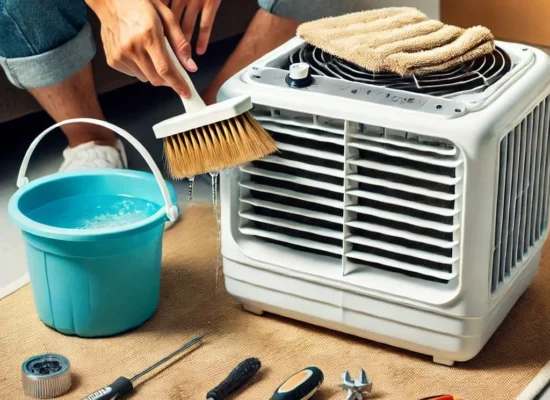
Dust or debris in accessible airflow areas may contribute to operating problems. With the cooler unplugged, clean accessible parts only as permitted by the manufacturer’s instructions.
Do not remove internal components simply to locate a noise. If normal cleaning improves airflow but the unusual sound remains, another component may be responsible.
For more detailed cleaning guidance, see the step-by-step air cooler cleaning guide.
Safe Troubleshooting You Can Do at Home
Keep troubleshooting limited to external checks that do not require electrical or mechanical disassembly.
Step 1: Switch off and unplug the cooler
Disconnect the power before cleaning or physically inspecting accessible parts. If there is smoke, sparking, exposed wiring or water around electrical connections, do not touch unsafe components.
Step 2: Check the cooler’s position
Make sure it stands securely on a stable, level surface. Check whether anything is touching the housing and contributing to vibration.
Step 3: Look for visible obstructions
Inspect accessible air-intake and outlet areas for dust, debris or objects that could interfere with airflow. Do not insert tools into the fan or motor assembly.
Step 4: Check the water level
If the model uses a water pump, check the water level according to the owner’s manual. Do not dismantle the pump or touch its electrical connections.
Step 5: Record when the noise occurs
From a safe distance, note whether the sound occurs continuously, changes with the operating setting, appears during water circulation or is accompanied by vibration or reduced airflow.
Do not deliberately run an appliance that is grinding severely, shaking dangerously or showing electrical warning signs just to reproduce the sound.
These observations can help a technician investigate the problem without relying on a sound-based guess.
For other symptoms, see the common air cooler problems and troubleshooting guide.
What You Should Not Repair Yourself
Unusual noise can involve components that are not safe for an untrained person to inspect or repair.
Avoid DIY work involving:
- Internal electrical wiring or connections
- Motor disassembly or replacement
- Bearing replacement
- Internal fan or blower adjustments
- Pump dismantling or pump electrical components
- Damaged power cords, plugs or switches
- Bypassing protective devices or attempting electrical testing
- Lubrication that requires opening the motor or accessing internal components
Disconnecting the power is an essential safety measure, but it does not make every internal repair suitable for DIY work. Follow the manufacturer’s instructions and seek qualified assistance when the repair requires specialist knowledge.
When Should You Stop Using a Noisy Air Cooler?
Stop operating the cooler if you notice:
- Smoke or sparks
- A burning smell
- Exposed or damaged wiring
- Severe or abnormal overheating
- Repeated electrical tripping
- Water reaching electrical components
- Sudden, severe grinding or other harsh mechanical noise
- Strong shaking that could make the appliance unstable
Switch off and disconnect the power if it is safe to do so. If the plug, socket or surrounding area is wet or otherwise unsafe to touch, do not handle it; keep clear and obtain appropriate assistance.
Do not restart the cooler until the underlying problem has been assessed.
How Can You Help Prevent Unusual Air Cooler Noise?
Regular maintenance may help reduce some noise-related problems, although it cannot prevent every mechanical or electrical fault.
Keep accessible areas clean
Remove surface dust and clean accessible vents and cooling pads according to the manufacturer’s instructions.
Maintain the water tank and cooling system
Follow the owner’s manual for water-level checks, tank cleaning and pump operation. Do not use unapproved chemicals or cleaning methods.
Keep the cooler stable
Place the appliance on a firm, level surface with enough clearance around its airflow openings.
Pay attention to changes in sound
A new or worsening sound deserves attention, especially when it occurs with reduced airflow, leakage, overheating or vibration.
Follow the correct model-specific instructions
Fan assemblies, pumps, motors and maintenance procedures vary. Consult the manual for the exact model rather than assuming that a procedure suitable for one cooler is appropriate for another.
When Should You Call an Air Cooler Technician?
Arrange professional inspection if:
- The noise continues after safe external checks.
- Grinding, squealing or buzzing is persistent or unusually loud.
- The cooler vibrates excessively.
- The motor struggles to start or the pump repeatedly stops.
- Airflow or water circulation changes unexpectedly.
- There is overheating, burning smell, sparking, electrical tripping or another safety concern.
The purpose of inspection is to identify the actual fault before deciding whether cleaning, adjustment, repair or component replacement is appropriate.
Frequently Asked Questions
Why is my air cooler making noise suddenly?
A sudden change can be associated with vibration, a loose component, a fan or motor problem, a pump issue or mechanical wear. The sound alone cannot confirm the cause.
Why is my air cooler making a rattling noise?
Rattling may be associated with loose external parts, vibration, nearby objects or a fan-related problem. Switch off and unplug the cooler before checking visible external parts.
Why does my air cooler make a grinding noise?
Grinding may indicate a mechanical or motor-related problem. Stop using the cooler if the noise is severe or persistent and arrange professional inspection.
Why is my air cooler making a buzzing sound?
A mild hum may be normal, depending on the model. A new or unusually loud buzz may involve the motor, pump or another component and should be investigated if it persists.
Can a water pump make an air cooler noisy?
Yes. A pump-related sound can change when water circulation is affected or the pump develops a fault. Check only the water level and operating settings described in the manual; leave internal pump repairs to a technician.
Can I lubricate my air cooler motor myself?
Do not assume that lubrication is appropriate for every model. Motor construction and manufacturer instructions differ. Avoid opening the motor or applying lubricant to internal components without model-specific instructions and appropriate expertise.
Can dirty cooling pads cause unusual noise?
Dirty pads can affect airflow and performance, but they are not automatically the cause of an unusual sound. Clean accessible areas according to the manufacturer’s instructions and seek inspection if the noise persists.
Should I continue using my air cooler if it is making a loud noise?
Not if the noise is severe, worsening or accompanied by strong vibration, overheating, a burning smell, smoke, sparks or electrical symptoms. Stop using the appliance and arrange inspection.
When should I arrange professional repair?
Arrange inspection when the noise persists after basic checks, the cooler’s performance changes, or you suspect a motor, bearing, pump or other internal mechanical or electrical fault.
Air Cooler Repair and Maintenance in Hyderabad
If your air cooler continues making unusual noise after safe external checks, professional inspection may help identify the cause.
Aircooler Clinic is a unit of FIXNEARME providing doorstep air cooler services in Hyderabad and applicable service areas. Service availability should be confirmed for your location, appliance and repair requirement.
Aircooler Clinic does not operate a separate physical service centre. The official FIXNEARME address should not be interpreted as an Aircooler Clinic walk-in repair location.
For service enquiries:
- Phone: 79971 00067
- Email: aircoolerclinic@gmail.com
- Website: Aircooler Clinic
When enquiring, mention the type of noise, when it occurs, your cooler’s brand and model if known, and any accompanying symptoms. Confirm service availability before arranging a visit.
Conclusion
An air cooler may make normal operating sounds, but a new, unusually loud or changing noise can indicate a problem with a component, water circulation, vibration or mechanical operation.
Start with safe external checks: verify the cooler’s position, look for visible obstructions and follow the manufacturer’s maintenance instructions. Do not attempt internal motor, bearing, pump or electrical repairs without the appropriate expertise.
If the noise persists, becomes severe or occurs alongside electrical warning signs or excessive vibration, stop using the cooler and arrange professional inspection rather than replacing parts based on sound alone.