How to Service an Air Cooler at Home: Safe Cleaning & Maintenance Guide
If your air cooler has started collecting dust, developing an unpleasant smell, giving weak airflow, or cooling less effectively, you can handle several basic maintenance tasks at home. The safest approach is to focus on cleaning and simple visual checks, while leaving electrical faults, motor problems, difficult disassembly and persistent mechanical issues to a qualified technician.
Before you begin, check your cooler’s owner manual. Different models use different cooling pads, pumps, filters, panels and water systems, so the manufacturer’s instructions should take priority over any general cleaning method.
What Can You Safely Do at Home?
For most air coolers, basic homeowner maintenance can include:
- Unplugging the cooler before cleaning
- Draining old water
- Cleaning the accessible water tank
- Cleaning or rinsing removable cooling pads according to the manual
- Removing dust from accessible fan or blower surfaces
- Cleaning air vents and the exterior
- Checking the water level
- Looking for visible water leaks
- Checking whether airflow is being blocked
These are maintenance tasks rather than electrical or mechanical repairs.
If the cooler has a damaged wire, burning smell, repeated electrical trips, motor problem, persistent pump failure or another fault that requires internal repair, stop the DIY work and arrange professional service.
Step 1: Switch Off, Unplug and Drain the Cooler
Safety comes first.
- Turn the air cooler off.
- Unplug it from the electrical socket.
- Move it to a suitable place where drained water will not damage the floor.
- Empty the water tank.
- Wait until accessible wet components have been drained before starting the cleaning process.
Never clean inside the appliance while it is connected to power.
Step 2: Clean the Water Tank
Standing water can leave behind dirt, mineral deposits and unpleasant odors.
After draining the tank:
- Wipe the accessible interior with a soft cloth or sponge.
- Remove visible dirt or residue.
- Use a mild cleaner only if it is suitable for the tank material and allowed by the manufacturer’s instructions.
- Rinse thoroughly.
- Make sure no cleaning residue remains before adding fresh water.
If your cooler has significant mineral scale, do not automatically assume that a particular chemical or descaling mixture is safe. Check the owner’s manual first.
Using clean, fresh water and avoiding long periods of stagnant water can help keep the tank in better condition.
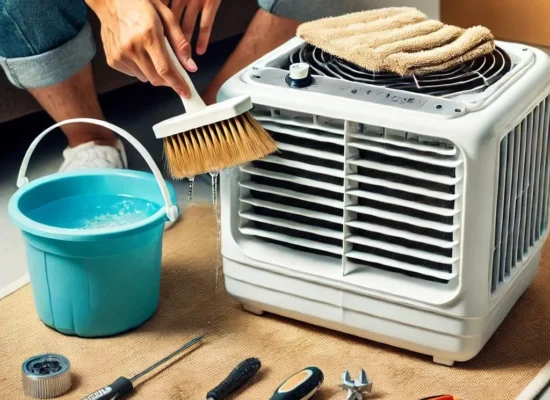
Step 3: Clean the Cooling Pads
Cooling pads are important to the evaporative cooling process. Dust, dirt and mineral deposits can restrict airflow and reduce cooling performance.
If your model has removable pads:
- Remove them according to the manufacturer’s instructions.
- Rinse them gently with clean water.
- Remove loose dirt without aggressively damaging the pad material.
- If the manufacturer permits a cleaning solution, use the recommended product or method.
- Rinse thoroughly.
- Allow the pads to dry as directed before reinstalling them.
Do not assume every cooling pad should be replaced after the same period. Pad material, water quality, operating conditions and usage all affect its condition.
Replace a pad when it is damaged, badly deteriorated, heavily scaled or no longer performs properly after appropriate cleaning, subject to the manufacturer’s guidance.
Step 4: Clean the Fan or Blower Area
Dust can accumulate around accessible fan blades, blower surfaces and air vents.
With the cooler unplugged:
- Remove only the panels that your owner’s manual says are user-serviceable.
- Use a soft cloth or brush to remove loose dust.
- Clean accessible fan or blower surfaces carefully.
- Keep water away from electrical components.
- Make sure cleaned parts are dry before the cooler is powered again.
Do not force a panel open simply to reach the motor or internal electrical components.
Step 5: Check Water Circulation
Many air coolers use a pump and water-distribution system to keep the cooling media wet.
A homeowner can check for obvious symptoms such as:
- Cooling pads remaining dry when they should be receiving water
- Little or no visible water circulation
- Debris around an accessible water inlet
- Unusual water leakage
If the pump does not operate, water circulation remains poor after basic cleaning, or accessing the pump requires significant disassembly, professional inspection is safer than attempting a repair yourself.
Step 6: Check Airflow and Ventilation
An air cooler needs adequate air movement around it to work effectively.
Check that:
- Air intake vents are not blocked.
- The outlet is not obstructed.
- Dust has not accumulated heavily around accessible vents.
- The room has suitable ventilation for the type of cooler being used.
If the cooler is running but the room remains uncomfortable, poor ventilation can be one possible factor. Cleaning the cooler alone cannot compensate for every operating-condition problem.
Step 7: Check for Visible Leaks
After cleaning, inspect the area around the water tank, drain and accessible connections.
A small amount of water during cleaning is expected, but a recurring leak during normal operation is different.
Possible sources include:
- A damaged tank
- A loose connection
- A drain problem
- A water-distribution issue
- A pump-related problem
Do not attempt to repair a persistent leak if doing so requires opening electrical or mechanical components.
What You Should Not Repair Yourself
Basic cleaning is different from appliance repair.
Avoid DIY work on:
- Electrical wiring
- Internal electrical connections
- Motor replacement
- Motor disassembly
- Capacitors or other electrical components
- Damaged power cords or plugs
- Complex pump repairs
- Internal mechanical faults
- Components that require extensive disassembly
A cooler that smells burnt, repeatedly trips electrical protection, produces unusual electrical sounds, has a damaged power cord or develops a persistent mechanical problem should be inspected professionally.
How Often Should You Maintain an Air Cooler?
There is no single maintenance interval that fits every air cooler.
A practical routine is:
During frequent summer use
- Check water regularly.
- Empty and refresh water as appropriate for your model and usage.
- Inspect cooling pads when airflow or cooling begins to fall.
- Clean visible dust from vents and accessible surfaces.
- Watch for odors, leaks and unusual noises.
During periodic maintenance
- Clean the water tank.
- Clean the cooling pads according to the manufacturer’s instructions.
- Clean accessible fan or blower surfaces.
- Check water circulation.
- Inspect the cooler for visible damage.
Before storing the cooler
- Drain the water.
- Clean the tank and accessible components.
- Clean the cooling pads as recommended by the manufacturer.
- Allow appropriate components to dry.
- Store the cooler in a dry, protected location according to the manufacturer’s storage instructions.
A maintenance schedule should be adjusted for dust levels, water quality, operating frequency, cooler type and the instructions supplied with the appliance.
Why Is My Air Cooler Still Not Cooling After Cleaning?
If you have cleaned the accessible components and the cooler still does not cool properly, do not assume that another round of cleaning will solve the problem.
Possible causes can include:
- Cooling pads that are worn or heavily scaled
- Poor water circulation
- A pump problem
- Blocked airflow
- Fan or motor problems
- A control or electrical fault
- Unsuitable room ventilation
- An issue specific to the cooler model
Start with the safe checks you can perform. If the problem remains, professional diagnosis is more appropriate than repeatedly disassembling the appliance.
When Should You Call a Professional?
Professional service is appropriate when:
- The cooler does not start.
- The motor is overheating.
- The fan makes persistent unusual noise.
- Water is leaking repeatedly.
- The pump does not circulate water.
- Cooling remains poor after cleaning.
- There is a burning smell.
- The power cord or plug appears damaged.
- The appliance repeatedly trips electrical protection.
- Internal components need to be opened or replaced.
- You are unsure how to safely access a component.
The important distinction is simple:
Clean what you can safely access. Do not attempt electrical or complex mechanical repairs without the appropriate knowledge and equipment.
Air Cooler Service in Hyderabad
If basic cleaning does not solve the problem, Air Cooler Clinic lists air cooler repair and maintenance services in Hyderabad. The business provides a phone number and email for service enquiries.
You can contact Air Cooler Clinic at 7997100067 or aircoolerclinic@gmail.com to discuss an air cooler repair or maintenance requirement.
Frequently Asked Questions
Can I service my air cooler at home?
Yes, you can perform basic maintenance such as draining the tank, cleaning accessible surfaces, cleaning removable cooling pads according to the manual, and removing dust from accessible vents. Electrical and complex mechanical repairs should be left to a qualified technician.
How do I clean an air cooler water tank?
Switch off and unplug the cooler, drain the water, clean accessible tank surfaces with an appropriate mild cleaner, rinse thoroughly and refill with fresh water. Follow your model’s manual if it specifies a particular cleaning method.
How do I clean air cooler cooling pads?
Remove the pads according to the manufacturer’s instructions, rinse them gently, clean them using an approved method and allow them to dry as recommended before reinstalling them.
Should I replace air cooler pads every year?
Not necessarily. Replacement depends on the pad material, condition, water quality, usage and manufacturer recommendations. Replace pads when they are damaged, badly deteriorated or no longer perform adequately after proper cleaning.
Can I repair the air cooler motor myself?
Motor repair should generally not be treated as a routine DIY maintenance task. Accessing or repairing the motor may require disassembly and can involve electrical or mechanical risks.
Why does my air cooler smell bad?
A stale smell can be associated with stagnant water, accumulated residue, dirty cooling media or inadequate cleaning. Drain and clean the accessible parts first. If the odor persists, professional inspection may be appropriate.
Why is my air cooler making unusual noise?
Possible causes include dust or an obstruction, a loose component, fan problems or a motor-related fault. After switching off and unplugging the cooler, check only the accessible areas described in the owner’s manual. Persistent or loud mechanical noise should be professionally inspected.
What should I do if my air cooler is leaking water?
First unplug the cooler and inspect accessible areas for obvious water accumulation, tank damage or a loose connection. If the leak continues during normal operation, arrange professional inspection rather than attempting an internal repair.
Does cleaning an air cooler improve cooling?
Cleaning can help when dust, dirt, mineral buildup or restricted airflow is affecting performance. However, poor cooling can also have other causes, such as water-circulation, fan, motor or environmental problems.
Final Takeaway
You do not need to dismantle an air cooler to perform useful maintenance at home.
Start with the basics: disconnect the power, drain old water, clean the tank, maintain the cooling pads, remove accessible dust, check airflow and look for visible problems.
If cleaning does not restore normal performance—or the problem involves electricity, the motor, persistent leakage or internal components—stop the DIY repair and seek professional assistance.
For air cooler repair and maintenance enquiries in Hyderabad, Air Cooler Clinic can be contacted at 7997100067 or aircoolerclinic@gmail.com.