How to Prevent White Dust Formation in Symphony Air Coolers
White dust around a Symphony air cooler can be a sign of mineral deposits from hard water, especially when chalky residue appears inside the water tank or on the cooling pads. Regular tank cleaning, appropriate water management and gentle pad maintenance can help reduce this buildup.
However, not every white particle found around a cooler necessarily comes from the water system. If dust continues to settle on furniture or appears to be coming through the airflow, investigate the source instead of assuming that mineral deposits are the only cause.
What Causes White Dust in a Symphony Air Cooler?
Air coolers use water to keep their cooling pads wet. When water evaporates, dissolved minerals can remain behind. Repeated use of mineral-rich water may gradually produce chalky deposits on surfaces that come into contact with water.
Hard water commonly contains dissolved minerals such as calcium and magnesium. Their accumulation can contribute to scaling in the tank, cooling pads and water-distribution system.
The most useful first step is to identify where the residue appears.
- Inside the tank: Chalky deposits may indicate mineral buildup.
- On the cooling pads: White or crust-like patches may indicate scaling.
- Around water outlets or distribution channels: Residue may accumulate where water repeatedly evaporates or dries.
- On furniture or across the room: The source is less certain. Mineral residue, ordinary household dust or another source may be responsible.
The appearance of the residue alone cannot confirm its composition.
How to Prevent White Dust Formation
1. Check Your Water Quality
If white, chalky deposits repeatedly appear inside the tank or on the cooling pads, water quality is worth investigating.
Where the water supply is high in dissolved minerals, using an appropriate lower-mineral water source may reduce the amount of mineral material entering the cooler. Filtered water does not always remove dissolved hardness minerals, so the result depends on the filtration method.
There is no universal requirement for every Symphony cooler to use RO or distilled water. Check the owner’s manual for your particular model before changing the water source.
For a fuller comparison of water choices, read our guide on whether to use filtered water in an air cooler.
2. Drain and Refresh the Water Regularly
Water left in a cooler for long periods can accumulate dirt and leave residue behind. Regular draining and refilling can help maintain a cleaner water tank and reduce the persistence of mineral deposits.
Follow these precautions:
- Switch off the cooler and unplug it before cleaning or draining it.
- Drain the water using the method specified in the owner’s manual.
- Check accessible tank surfaces for visible sediment or scale.
- Refill with clean water appropriate for the model.
- Drain the tank when the cooler will remain unused for an extended period.
The appropriate maintenance frequency depends on the cooler, water quality and usage. Follow the manufacturer’s instructions rather than treating a single schedule as suitable for every model.
3. Clean the Cooling Pads Gently
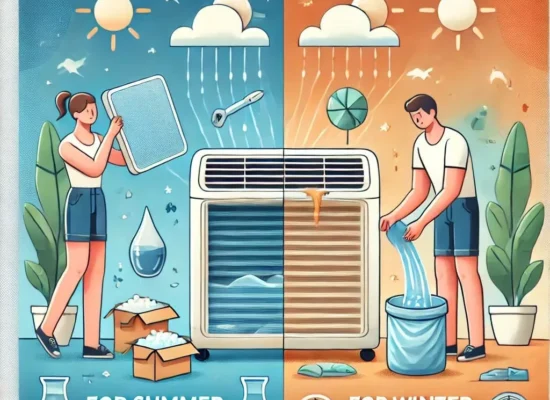
Cooling pads can collect dust and mineral deposits during normal operation. Excessive buildup may interfere with water distribution and airflow.
For routine maintenance:
- Switch off and unplug the cooler.
- Allow the water to drain as required.
- Inspect the cooling pads for chalky deposits, dirt, deterioration or uneven wetting.
- Clean the pads only using the method permitted by the manufacturer.
- Allow the components to dry as instructed before returning the cooler to use or storing it.
Some Symphony manuals specify gentle water application and warn against high-pressure jets and acidic water for pad cleaning. Consequently, do not automatically use vinegar, descaling chemicals or aggressive scrubbing.
If the pads are heavily scaled, damaged or remain blocked after appropriate cleaning, check the manufacturer’s replacement guidance.
4. Keep the Water Distribution System in Good Condition
The water distribution system helps supply water to the cooling pads. If water does not reach the pads evenly, some areas may remain dry while others collect residue.
During routine maintenance, look for visible signs such as:
- Unevenly wetted cooling pads
- Chalky deposits around accessible water outlets
- Reduced water circulation
- Repeated mineral buildup in the tank
Switch off and unplug the cooler before inspecting accessible components. Do not open electrical compartments or dismantle internal pump assemblies unless you are appropriately qualified.
Persistent blockages or uneven water distribution may require professional inspection. Symphony also identifies tank scaling and water-distribution cleaning as relevant preventive-maintenance tasks.
5. Avoid Unverified Cleaning Chemicals
Vinegar, acidic descalers, antiscalant products and water-treatment chemicals are not automatically suitable for every cooler.
An unsuitable chemical can damage a component or conflict with the manufacturer’s cleaning instructions. Do not add a treatment product to the tank simply because it is advertised for scale prevention.
Before using a cleaning or water-treatment product:
- Check the owner’s manual.
- Confirm that the product is suitable for the cooler’s materials and water system.
- Follow the product instructions and any applicable manufacturer restrictions.
- Rinse components only as directed.
If the manual does not establish a safe cleaning method for substantial mineral buildup, seek appropriate service advice rather than experimenting with chemicals.
6. Inspect the Pads and Tank for Persistent Scale
Routine cleaning can help control mineral buildup, but established deposits may not disappear with a simple rinse.
After the cooler has been switched off, unplugged and safely drained, inspect accessible areas for:
- Thick or crust-like deposits
- Damaged or deteriorated pad material
- Uneven water distribution
- Recurring residue shortly after cleaning
- Reduced airflow or cooling performance
Do not assume that cooling pads must be replaced after a fixed number of months. Their condition, the cooler model, water quality and the manufacturer’s recommendations determine when replacement is appropriate.
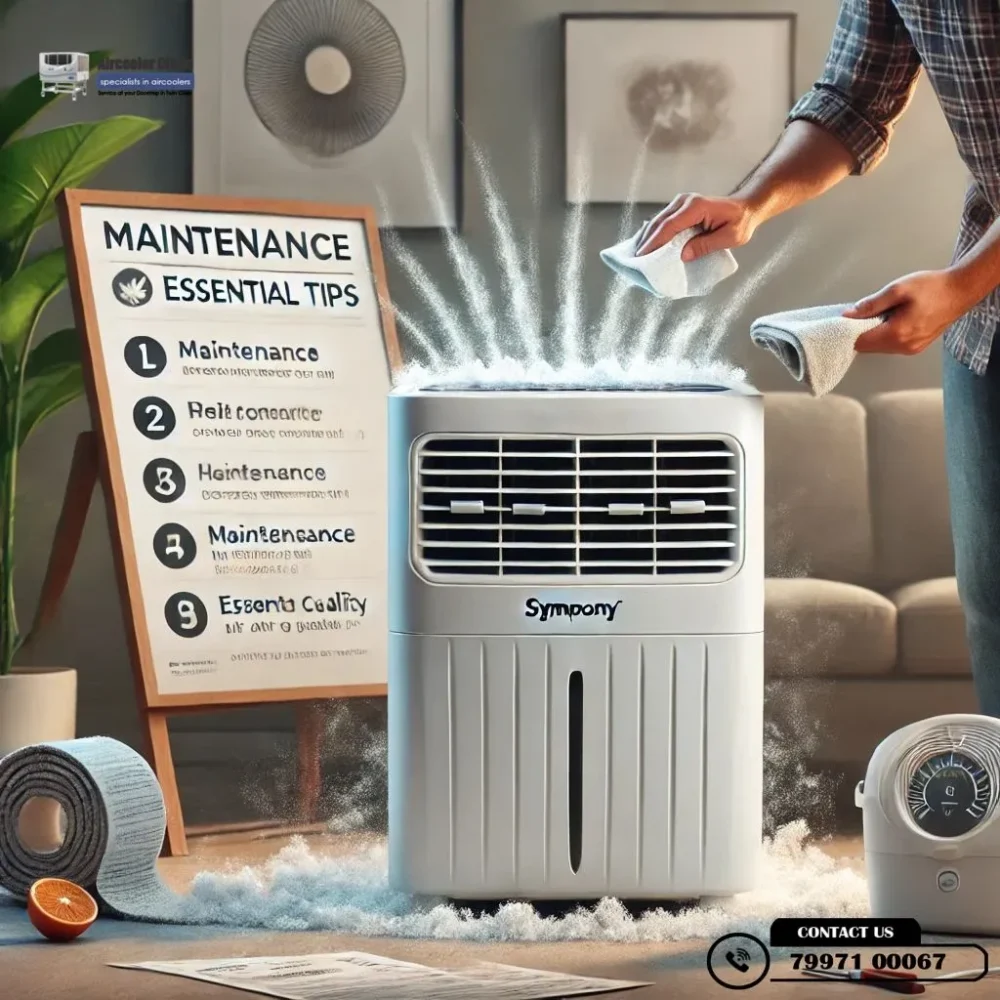
For broader guidance on safe cleaning and routine checks, see our essential air cooler maintenance guide.
What If White Dust Continues to Appear in the Room?
White particles on furniture, shelves or other room surfaces are not enough to establish that the cooler is producing mineral dust.
Use the following approach:
- Look for the pattern. Check whether the residue is concentrated near the cooler, inside the tank or on the cooling pads.
- Inspect for visible scale. Chalky deposits in water-contact areas make mineral buildup a plausible explanation.
- Check other possible sources. Household dust, construction residue and other airborne particles may produce a similar appearance.
- Clean the cooler safely. Follow the instructions for the exact model and avoid unsuitable chemicals.
- Reassess the problem. If residue continues to accumulate, or if the source remains unclear, arrange an appropriate inspection.
Do not assume that white dust is harmless or that it necessarily presents a particular respiratory risk. Its composition and source have not been established merely by its colour.
If anyone experiences persistent irritation or breathing symptoms, seek appropriate medical advice rather than relying on an appliance-cleaning routine to address the symptoms.
When Should You Seek Professional Assistance?
Routine cleaning may be sufficient when the issue is limited to accessible mineral residue. Professional assistance is more appropriate when:
- Heavy scale persists despite manufacturer-approved cleaning.
- Water does not circulate evenly through the pads.
- The pump repeatedly fails or the cooler’s cooling performance declines.
- Water leaks into areas near electrical components.
- The cooler produces a burning smell, causes an electric shock or repeatedly trips the electrical supply.
Stop using the appliance if you notice an electrical safety problem. Do not open internal electrical compartments or attempt live electrical repairs.
For model-specific maintenance, consult Symphony’s preventive-maintenance guidance and the owner’s manual for your exact cooler.
Frequently Asked Questions
Why does my Symphony air cooler have white deposits?
Hard water can leave mineral deposits when water evaporates repeatedly. If the residue is concentrated in the tank or on the cooling pads, mineral scaling is a plausible cause. The appearance alone does not prove that every white particle has the same source.
Should I use RO or distilled water in my Symphony cooler?
Not necessarily. A lower-mineral water source may help reduce deposits in some circumstances, but the suitable choice depends on the model and the available water. Check the manufacturer’s instructions before changing your water source.
Can I clean Symphony cooling pads with vinegar?
Do not assume vinegar is suitable. Some Symphony cooler manuals warn against acidic water when cleaning pads. Follow the instructions for your specific model and use only permitted cleaning methods.
How often should I clean the water tank and cooling pads?
There is no single interval that applies to every cooler. Water quality, usage, dust levels and the particular model affect maintenance needs. Inspect the cooler regularly and follow the owner’s manual for cleaning frequency.
Does white dust always come from the air cooler?
No. Household dust and other airborne particles can look similar. Check for mineral deposits inside the tank and on the pads, but investigate other possible sources if the residue is mainly found around the room.
When should cooling pads be replaced?
Replacement depends on the pad’s condition and the manufacturer’s recommendations. Damaged, badly deteriorated or persistently clogged pads may require replacement, but a fixed replacement interval should not be assumed for every model.
Conclusion
To reduce white dust associated with a Symphony air cooler, investigate the water quality, keep the tank clean, maintain the cooling pads according to the owner’s manual and monitor the water-distribution system. Use only approved cleaning methods and avoid unverified chemicals.
If the residue continues to appear, determine whether it is mineral scaling inside the cooler or airborne dust from another source. Correct identification and model-appropriate maintenance are more useful than applying the same cleaning treatment to every cooler.
Air Cooler Clinic — Doorstep Maintenance Assistance
Aircooler Clinic is a unit of FIXNEARME providing doorstep air cooler services in Hyderabad and applicable service areas. Aircooler Clinic does not operate a separate physical service center.
For service enquiries, contact Air Cooler Clinic at 79971 00067 or aircoolerclinic@gmail.com, or use the online complaint-booking page.
The official FIXNEARME address is:
FIXNEARME
4-7-112/4/1, UMA RESIDENCE,
RAGHAVENDRA NAGAR COLONY, BAGH HAYATHNAGAR,
HAYATHNAGAR, RANGAREDDY-501505
This is the parent organization’s official address, not a separate Aircooler Clinic walk-in service center. Confirm service availability for your location when booking.